A strong legal foundation is essential to combat torture. The UN Convention against Torture highlights a number of specific areas where legislation is required, while the Committee against Torture has recommended or encouraged additional elements. CTI assists States in drafting and adopting legislation that prohibits, prevents and responds to incidents of torture and other ill-treatment.
National anti-torture legislation: Basic elements
Criminalising torture
Defining torture as a separate, specific offence with appropriate penalties that reflect the gravity of the crime.
Complaints and investigations
Providing in law the right to report torture and mandating impartial investigations.
Read CTI’s Implementation Tool on complaints and investigations here.
Exclusion of torture-based evidence
Prohibiting use of evidence obtained through torture and other ill-treatment in any proceedings.
Read CTI’s Implementation Tool on non-admission of evidence obtained by torture and ill-treatment here.
Non-refoulement
Prohibiting deportation of individuals to places where they risk torture and other ill-treatment.
Read CTI’s Implementation Tool on non-refoulement here.
Remedies for victims
Guaranteeing the right to redress for victims and their families, including compensation and rehabilitation.
For examples of legislative provisions for redress, read CTI’s Implementation tool here.
Safeguards during arrest and detention
States have adopted a wide range of laws and regulations providing for basic rights of persons to be guaranteed following arrest, in police custody and during the initial period of detention by police and other law enforcement authorities. These have the positive effect of addressing risks of torture and other ill-treatment in the period when these are known to be higher, as well as of streamlining and supporting the overall administration of justice.
Clear regulations covering the standards of conduct for police and law enforcement, security services, prison services and other relevant bodies, coupled with training on those standards, are regularly adopted by States working towards UNCAT implementation. These often include regulating arrest and stop and search procedures, the use of force and firearms in custodial and extra-custodial settings, or detailing the minimum material conditions of detention.
CTI has produced a guide and other documentation to assist States as they review their legislative provisions for compatibility with UNCAT, and take decisions on how they could be improved.
CTI partnered with the Association for the Prevention of Torture (APT) to produce a Guide on anti-torture legislation, intended to assist lawmakers in drafting anti-torture legislation and in revising existing domestic laws. It is helpful also for other actors such as national human rights institutions, national preventive mechanisms, actors from civil society or international and regional organisations advocating for or supporting the adoption of an anti-torture legal framework at the national level.
The guide is structured to explain the primary (compulsory), recommended and optional elements requiring domestic legislation.
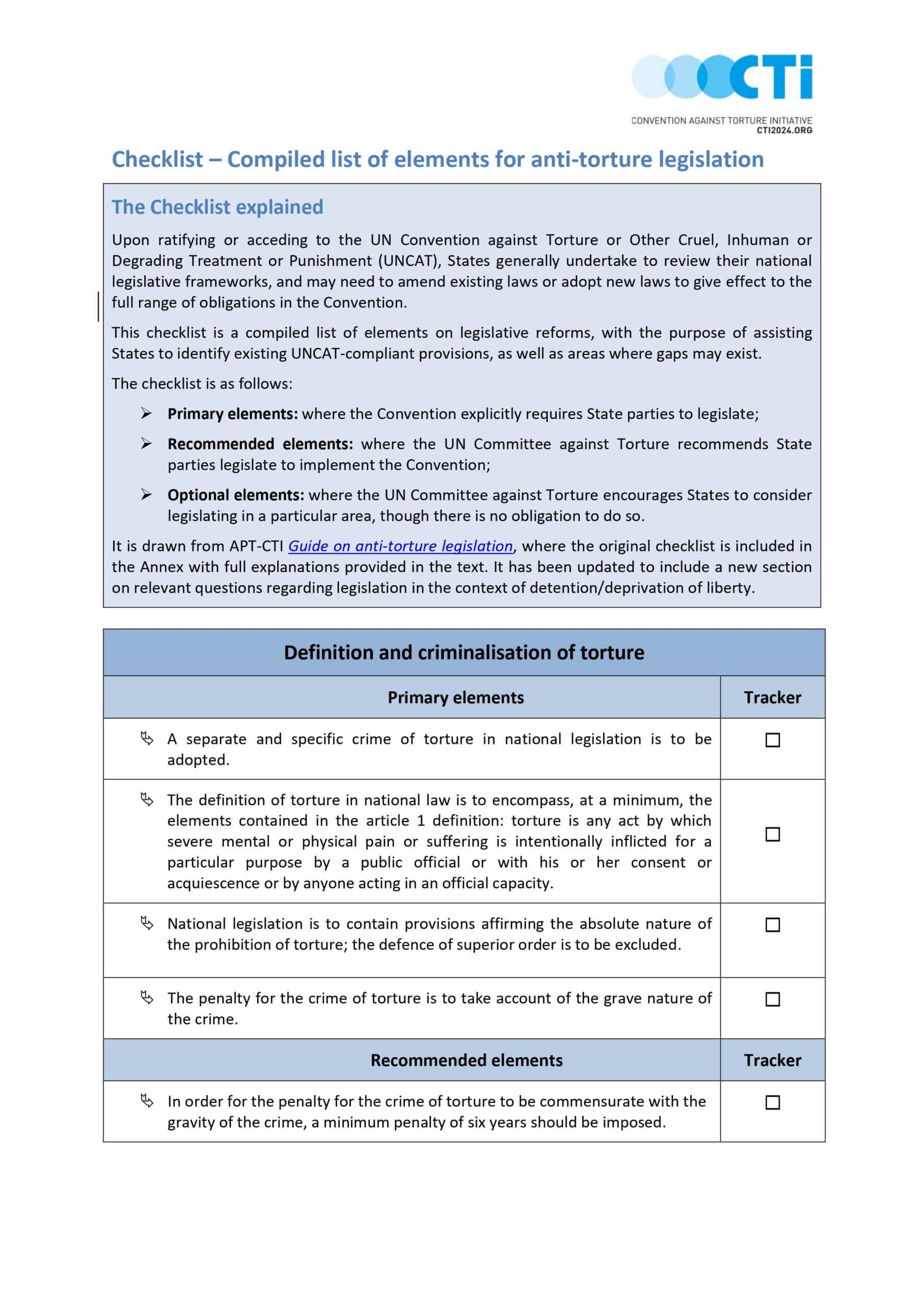
Complementing the APT-CTI Guide on anti-torture legislation, CTI developed a legal checklist to assist States in their efforts to review and amend national laws to be compliant with UNCAT, by identifying existing UNCAT-compliant provisions, as well as are areas where amendments might be needed.
This publication on legislative practices and trends in respect of anti-torture legal frameworks in Latin America and the Caribbean captures the experiences of both civil and common law systems and covers 17 Latin American and 14 Caribbean countries. It provides States in the region and beyond and other relevant stakeholders with valuable examples of anti-torture legislative and institutional frameworks in Latin America and the Caribbean, and further identifies gaps where further progress could be advanced.
The comparative overview is available in English and Spanish.
Stand-alone or mainstreamed legislation?
Those opting for a stand-alone anti-torture law tend to be countries that have a history of political torture or are emerging from situations of violent conflict or oppression, and seek to make a purposeful statement against torture. Other countries needing extensive amendments of different pieces of legislation have often found adopting a stand-alone anti-torture law as the most pragmatic approach. Many other States have opted to ensure legislative coherence and consistency by “mainstreaming” torture prevention provisions within existing statutes.
Legislative review and drafting strategies
As States parties embark on the process of implementing the Convention, most start with assessing their existing laws and, where needed, domesticating basic anti-torture provisions.
One of the frequently asked questions by legislative drafters, such as the Attorney General’s Office, national law commission, or other assigned bodies, as they embark on the process of reviewing the existing legislative framework, is whether it is more appropriate to:
Draft specific standalone anti-torture legislation, with a view to implementing the Convention in full or partially;
Amend existing legal provisions in various pieces of legislation, including the repeal of laws or provisions that are incompatible with the Convention; or
A combination of the two
Early consultation with a wide range of stakeholders will help identify the best option in the relevant country’s context. There is no prescribed or preferred approach, as it largely depends on the country’s legal system and domestic context.
Contact our experts
CTI’s expert team responds confidentially to governments and national institutions, offering one-to-one technical support on a wide range of issues relevant to the implementation of UNCAT – such as police and law enforcement, legislative review and reform, policy drafting, prison reform, complaints, investigations and prosecutions, and redress for victims. We have advised many governments and supported them in taking action on torture prevention, eradication and redress.