These tools offer support, guidance and ideas for State practitioners and policymakers as they develop or revise context-specific strategies, mechanisms and procedures for the effective implementation of UNCAT.
Torture prevention strategies are aimed at effectively reducing risk factors and eliminating the root causes allowing torture to occur. This tool compiles 14 examples of measures States have taken to prevent and respond to torture and ill-treatment, such as national anti-torture strategies, national human rights action or development plans, and agency operational plans. It also provides guidance on elements to consider when developing torture prevention strategies.
Recognising that there is a heightened risk of torture and ill-treatment during arrest and the first hours in police custody, this tool addresses legal and procedural safeguards against torture and ill-treatment. Compiling 21 examples of such safeguards, this will assist States in identifying gaps where reforms may be needed and will inspire good practices in UNCAT implementation.
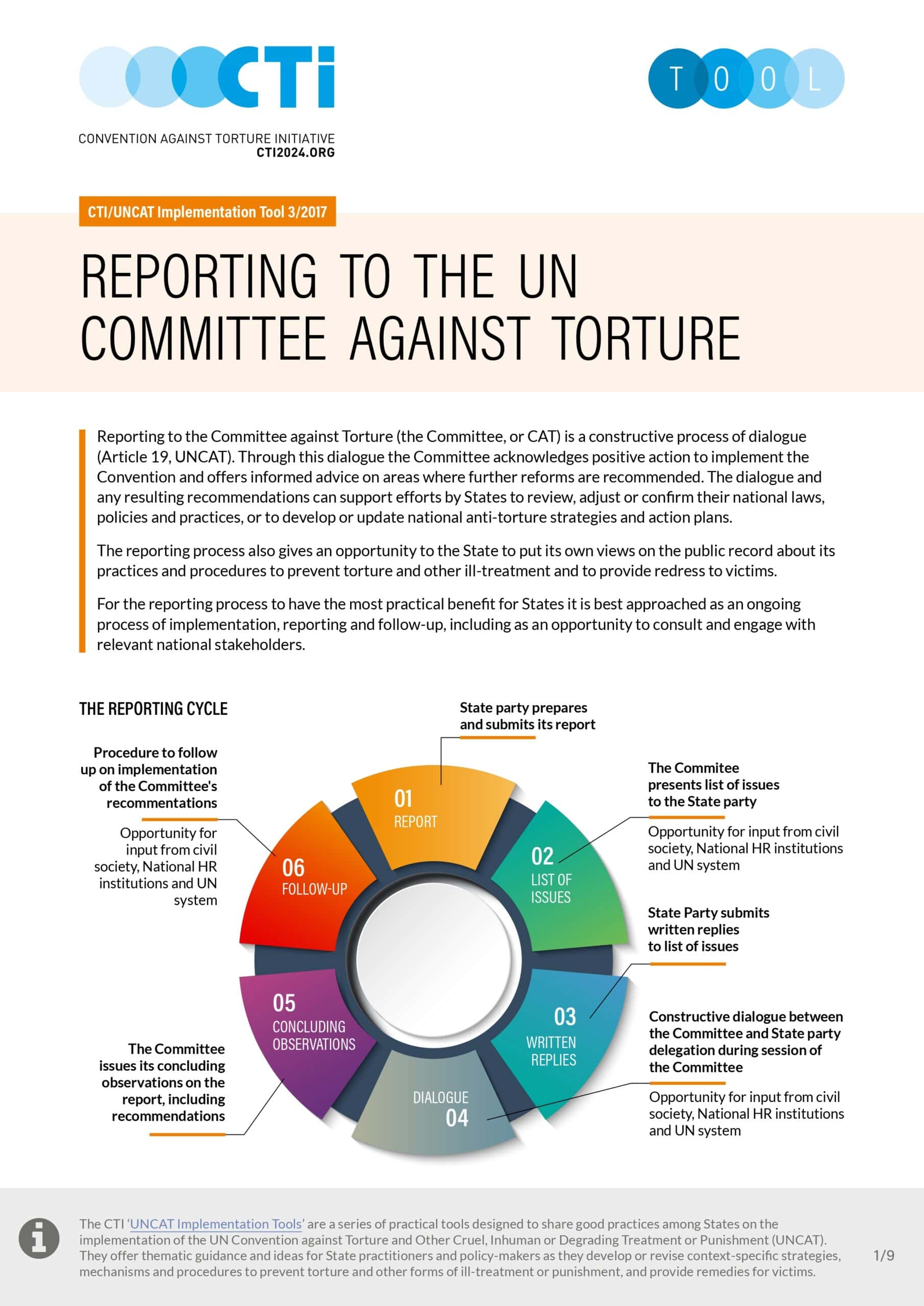
Reporting to the UN Committee against Torture (CAT) is a key obligation, and positively gives the State an opportunity to engage in a constructive way on their implementation efforts and to receive advice on areas where further reforms may be recommended. This tool highlights the main steps of the reporting cycle, compiles State practices and experiences on reporting to CAT, and showcases some effective measures to streamline reporting, implementation and follow-up to the Committee’s recommendations.
The principle of non-refoulement, or the prohibition against expulsion, return or extradition of persons to a place where they face a real risk of torture or ill-treatment, is a basic UNCAT obligation. Drawing on 33 examples of domestic legislation and procedures incorporating the principle of non-refoulement, this tool shows how the principle can be respected in practice.
Providing rehabilitation to victims of torture and ill-treatment restores physical, mental, social and vocational independence and is one of the components of the right to redress. Sharing 20 State practices and examples of laws, policy guidance, action plans, types of rehabilitation services and funding models, this tool is to inspire States to learn from each other in their efforts to improve access, availability and quality of domestic rehabilitation services.
A general principle of UNCAT is that States are required either to prosecute or extradite an alleged perpetrator of torture in their territory, in order to eliminate safe havens and end impunity for serious crimes. This tool outlines the different elements of UNCAT’s extradition framework and how it fosters cooperation and mutual legal assistance between countries. 26 examples of States’ treaties, laws, policies, procedures and practices are included.
Putting in place procedures that enable persons to bring complaints of torture and ill-treatment, and promptly investigating allegations, prevents re-occurrence, improves transparency and accountability and combats impunity. These 35 State practices and examples from across the world will inspire better practices.
The importance of the rule that evidence obtained by torture and ill-treatment shall never be admitted into court proceedings (also known as the “exclusionary rule”) is threefold: it removes incentives to coerce confessions or information from suspects and witnesses; safeguards the fairness of court proceedings; and protects individuals’ rights to due process. 22 examples of legislative, policy and practical measures and procedures are contained in the tool. It is written for police and other investigators and interviewers, prosecutors, medical practitioners and judges, and outlines the steps they can take to ensure torture evidence is never used.
Corporal and other cruel or degrading forms of punishment are forms of violence and States must take all appropriate legislative, administrative, social and educational measures to eliminate them. This tool offers 30 examples of State good practices in implementing positive discipline approaches through education, training and awareness-raising, adopting legislation prohibiting corporal punishment and developing comprehensive policies to prohibit such practices.
An Initial Medical Assessment (IMA) is an evaluation by a doctor or other qualified healthcare professional of all detainees as soon as possible after their arrival in a place of detention. The IMA is an important means for the early identification of cases of torture and other cruel, inhuman or degrading treatment or punishment (ill-treatment). It helps ensure the appropriate medical and psychological treatment of victims of torture or other ill-treatment, and provides an opportunity for the referral of any such cases to the relevant authorities for investigation and prosecution. Effective IMAs may also serve as a strong deterrent for perpetrators and thus have a key role to play in the prevention of further acts of torture. This tool illustrates good practice examples of legislative, policy and practical measures and procedures adopted by States to ensure effective IMAs.
CTI’s expert team responds confidentially to governments and national institutions, offering one-to-one technical support on a wide range of issues relevant to the implementation of UNCAT – such as police and law enforcement, legislative review and reform, policy drafting, prison reform, complaints, investigations and prosecutions, and redress for victims. We have advised many governments and supported them in taking action on torture prevention, eradication and redress.